
Master the Planetary KP Index, solar wind speed, IMF Bz orientation, and satellite cloud models to successfully hunt Aurora Borealis in Murmansk — field tactics by Vielatin.
Over 15 years operating Arctic expeditions in Northern Russia and leading specialized winter journeys, one of the most common misconceptions travelers have is: "A high KP index (KP 4-5) guarantees an epic aurora display, while a low index (KP 1-2) means disappointment." In reality, field experience proves otherwise. Many nights our groups witnessed explosive magenta and violet substorms under KP 1.5, while other nights under KP 5 storms were obscured behind stubborn cloud covers. Aurora hunting is a meticulous combination of space weather physics and Arctic micro-meteorology. Here is your definitive field guide.
1. What Is the Planetary K-Index (KP)? Understanding the 0–9 Scale
The Planetary K-index (KP) quantifies geomagnetic disturbances caused by solar wind interacting with Earth's magnetosphere. Ranging from 0 to 9, it is updated every 3 hours by NOAA’s Space Weather Prediction Center (SWPC):
- KP 0 – 1 (Quiet): Minimal geomagnetic activity. The Auroral Oval remains contracted close to magnetic polar regions (above 70°N).
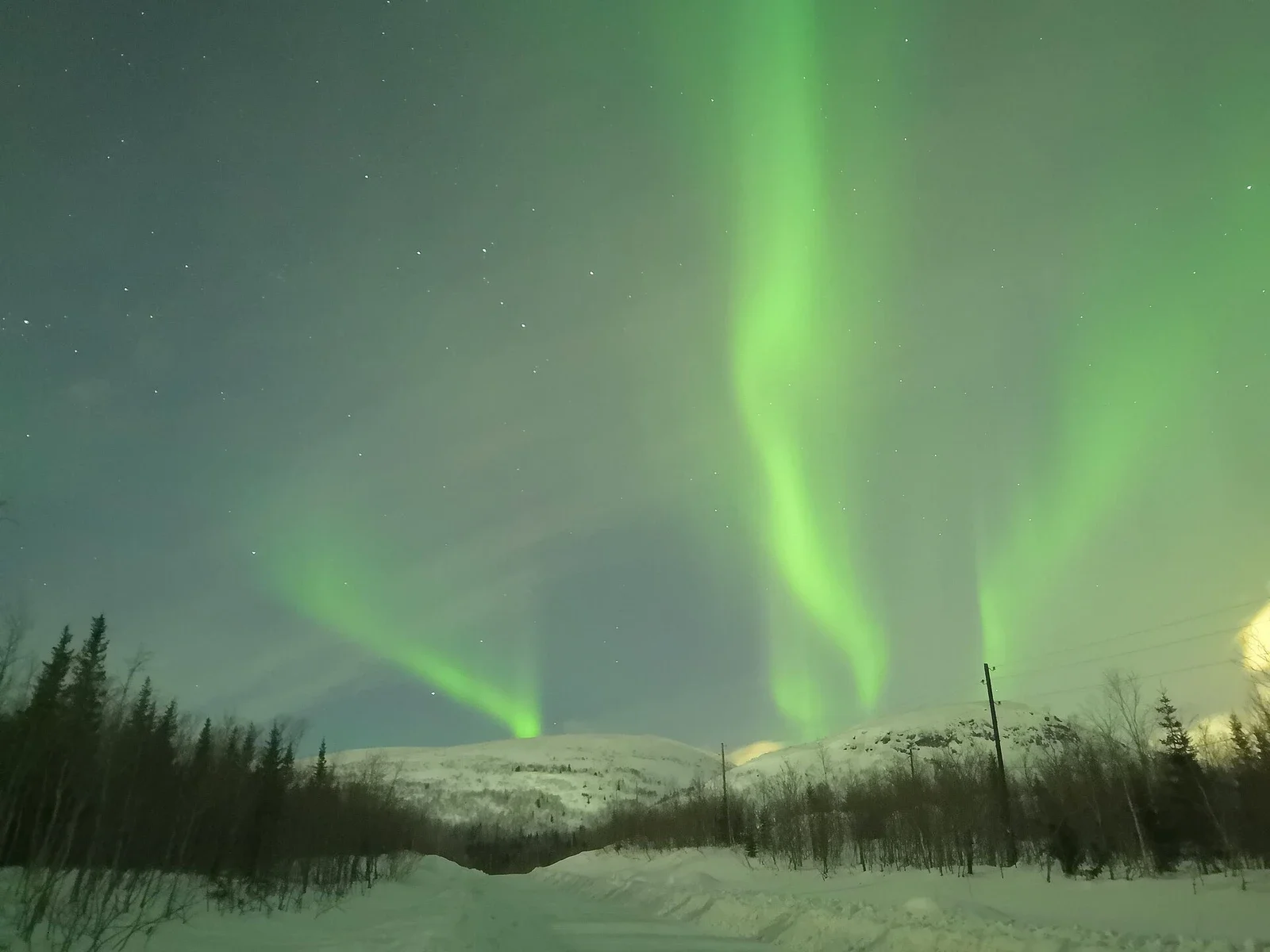
- KP 2 – 3 (Unsettled): Moderate geomagnetic activity. Stable green auroral arcs are readily visible within the Arctic Circle.
- KP 4 (Active): Dynamic ribbons and curtains undulating across the night sky.
- KP 5 (Minor Geomagnetic Storm G1): Fast-moving auroral dancing; naked-eye visible purple and pink upper fringes.
- KP 6 – 9 (Major Storms G2 to G5): Rare coronal mass ejections; auroras become visible down to mid-latitudes such as Moscow or Central Europe.
👉 The Geographic Advantage of Murmansk: Murmansk sits at 68°58′ N, located directly under the natural Auroral Oval. At this high latitude, you only need KP 1.5 to 2.0 to witness vibrant auroral arcs, provided the sky is clear.
2. Key Space Weather Drivers: The IMF Bz Factor
Professional aurora chasers monitor beyond the basic KP index to track real-time satellite data:
- Interplanetary Magnetic Field Bz (IMF Bz): Earth's magnetic shield points North. When solar wind magnetic polarity turns South (Negative Bz, measured in nT), it creates magnetic reconnection, allowing solar electrons to pour into our upper atmosphere. A negative Bz (-5 nT to -15 nT) is the true catalyst of bright auroras.
- Solar Wind Speed (km/s): Baseline solar wind flows at 300-350 km/s. Coronal hole streams can accelerate this beyond 500-750 km/s, triggering rapid dancing curtains.
- Proton Density (p/cm³): Elevated densities above 15 p/cm³ create intense geomagnetic compression.
3. Ground Meteorology: Why Satellite Cloud Cover Dictates Success
Auroras occur between 80 km and 600 km above Earth, while weather clouds sit below 10 km. No matter how powerful the solar storm is, 100% low overcast clouds will block all visibility. Vielatin chasers continuously monitor high-resolution satellite cloud feeds from Windy (ECMWF model) to exploit micro-climate clearings across the Arctic tundra.
4. Mobile Aurora Chasing with Vielatin Expeditions
Instead of waiting stationary at a hotel, Vielatin operates dynamic 4WD expedition chases, covering 80 km to 180 km each night across the Kola Peninsula to find crystal-clear skies, ensuring an optimized sighting experience across 3–4 chase nights.
👉 Explore Official Expeditions: 8D7N Russian Arctic Aurora Expedition (All-Inclusive) or 7D6N Arctic Land Tour Experience.
Ready to Embark on this Extraordinary Journey?
Let Vielatin's seasoned route experts craft your bespoke itinerary, secure exclusive lodges, and support you 24/7 on the trail.


 Flagship Journey 2026 - 2027